Lost


The Snow Goose

The Snow Goose by Paul Gallico

Our house, like most I imagine, has themes that run through the events taking place there.

One of my wife’s themes is lost, or missing, expressed in phrases commonly heard here such as “I’m sure I had a copy of that book…” or “I can’t believe I would have got rid of that book..”

It’s not always a book, occasionally it’s something else, perhaps a CD or LP, or an ornament. But it is usually a book.

The reason for this theme is our history. My wife, Kathie Touin, is a Californian who was living in Washington state in north-west USA when we met. I am English and, at the time, was living in London.

We married after what I suppose you would call a whirlwind romance. Incidentally, is this the only possible positive use of the word whirlwind, other than when Dorothy’s house fell on the Wicked Witch of the East?

Anyway, when we married 10 years ago – I mean Kathie and me, not the Wicked Witch of the East, I never married her – we set up home in my then flat in Ealing, London.

In the weeks leading up to the big move Kathie spent most of her time sorting out her possessions, giving much away to friends and charity, before packing what was left in boxes which were freighted from Washington to Ealing.

Incidentally, it would have been fun to travel with the boxes – we assume they went down the US west coast, through the Panama Canal, across the Atlantic, before finally arriving in Essex for the less interesting part of their journey.

When Kathie’s possessions eventually got to our flat some were unpacked and many went into our storage unit. Some boxes were never unpacked or sorted until we moved to Orkney three years ago.

And so, with the long passage of time between packing and unpacking, Kathie still puzzles over books she thinks she once had or can’t believe she gave away.

It is one of the amusing themes of our home-life – but now it has happened to me.

My late mother had a lovely copy of the book, not much more than a short story really, The Snow Goose by Paul Gallico. I think it is properly described as a novella. I’m pretty sure my mother’s copy was an illustrated edition and, some years before she died, she gave the book to me.

Since moving to Orkney and semi-retirement I’ve determined to catch-up on my reading and also with the many CDs I have bought over the years but never played.

As I mentioned on Twitter, I opened my Patsy Cline four-CD box-set to listen to for the first time the other day, only to discover a receipt which says I bought it 20 years ago this month. As my Twitter friend @myraponeill pointed out, quoting Patsy: “Crazy…”

Anyway I decided it was well past time to read The Snow Goose. I’ve never seen the film – starring Richard Harris and Jenny Agutter – but not so long ago there was a BBC Radio 4 adaptation which reduced me to tears. I have a cassette tape of it – err, somewhere.

The Snow Goose is the story of a lone artist, a young girl and an injured snow goose; a story of war; a story of love, loss and friendship; and a story of the power of nature.

However, I have failed to find the book. This despite the fact that we recently bought extra bookcases and all our books are finally, we think, out on display.

I was rather upset that I could lose a book which my mother had given me and which, I know, was special to her. Because it is a tale of love and loss, and my mother is no longer alive, its loss seemed all the more poignant.

Please don’t think I am careless. I have other books and possessions which my mother gave me. One of the most precious is her 1948 copy of the Oxford Book Of English Verse, which she has signed “Mary E Smith”.

And so I have bought another copy of Paul Gallico’s The Snow Goose, over the internet, it was not illustrated, and not expensive, and I am about to read it for the first time.

I am hoping that buying a second copy will make my mother’s copy somehow turn up, in a box, tucked into another book, somewhere… But that is perhaps hoping for too much.

Graham Brown

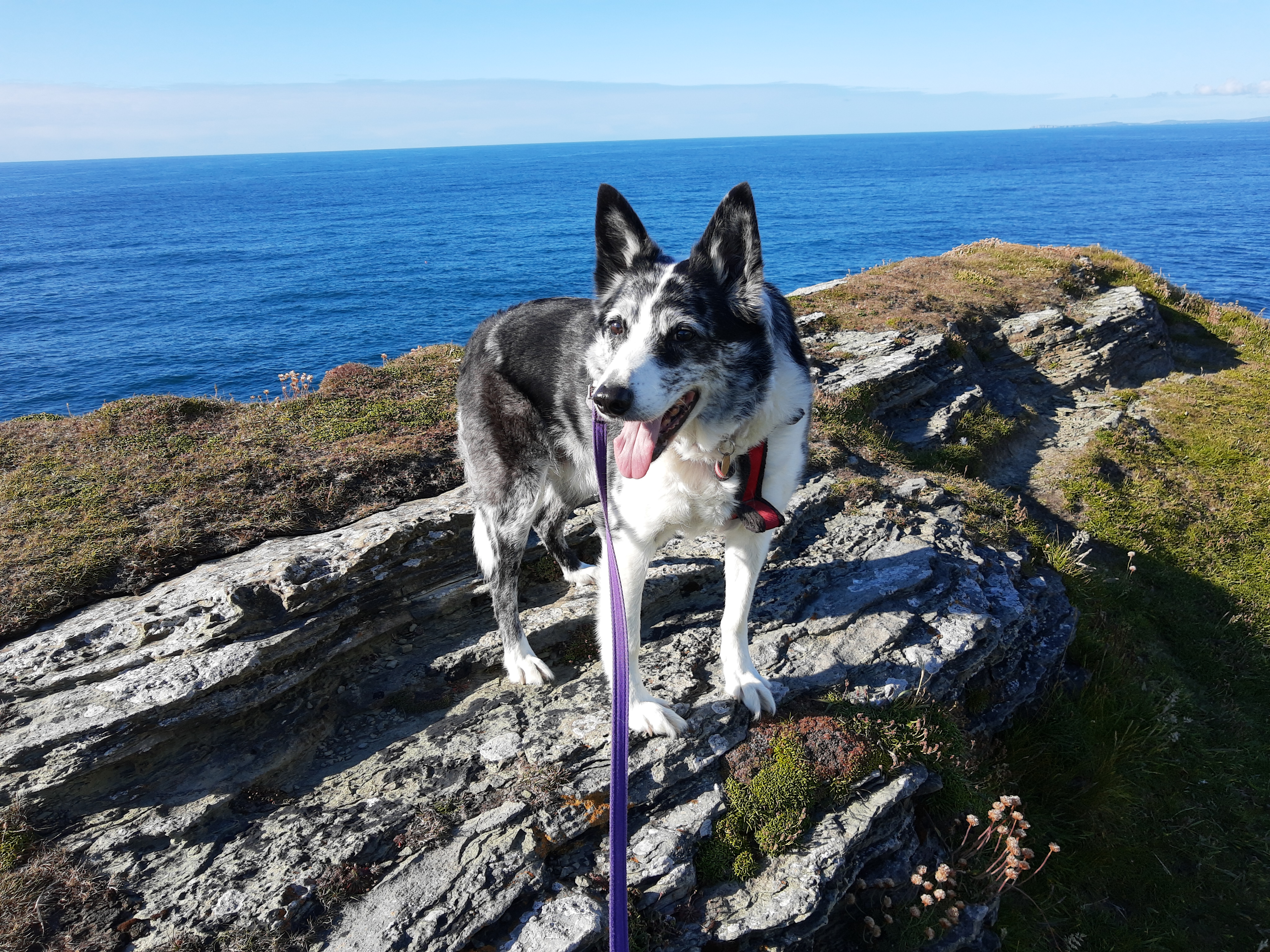
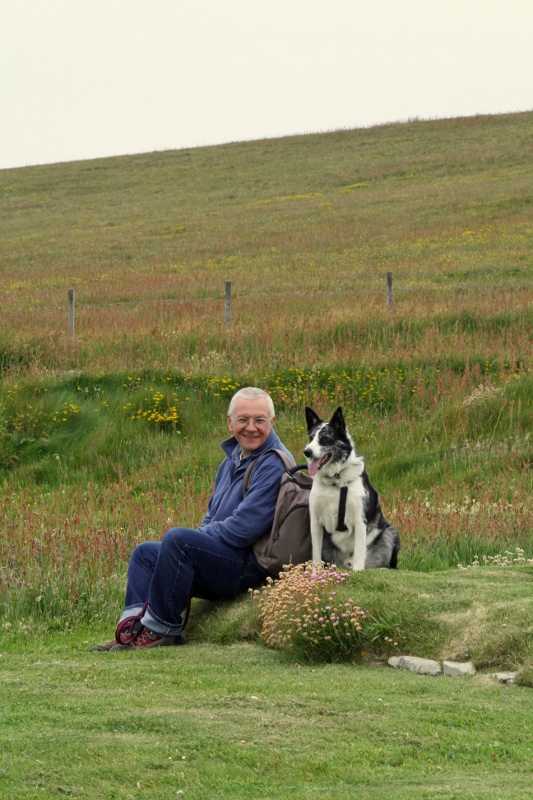
How one rescue dog changed our lives

Roscoe's first picnic

Roscoe’s first picnic

A few weeks ago, for the first time in many years, I watched coverage of the Crufts dog show on television. It occurred to me that, speaking very generally and not critically, dog people are a bit mad. Perhaps eccentric is a better word.

And now I’m one. A dog person I mean, not a dog.

When I was a child we had a dog and I have always liked them but didn’t particularly feel the need to have one as an adult.

Then, last year, my wife Kathie Touin started a not-so-subtle campaign to get a dog. By which I mean she kept saying how she would like a dog and how it would improve our lives.

I wasn’t convinced and pointed out that the dog would need regular walks, and did we have the time for this? We would also have to think about what to do on holidays, there are so many places you can’t take a dog. Would you be prepared for that inconvenience?

And, I said, what about the cost of kennels when we visit relatives in the USA? And what about vet’s bills?

Oh, said Kathie, “I’ll look after the dog and take it out for walks, and I’m sure we could afford one.” I wasn’t convinced.

Kathie continued her campaign and started to talk to local dog owners about caring for dogs, and about where might be a good place to find one.

Then Kathie got to hear about a three-year-old collie who was in kennels after his owner had died. A local support group had sprung up – there is no formal pet rescue here in Orkney – of people who had fallen in love with him and who were fund-raising to pay for his bills.

Could we go and see him?

Well, of course, that was it. Once we met this dog I couldn’t resist him and his hard-luck story. So, last summer, we became dog owners.

Roscoe's shy trick

Roscoe’s shy trick

I can’t say too much about his past life but he didn’t have the best start. We chose a new name – Roscoe – because we were advised that he was probably familiar with his old name being shouted at him to tell him off. Roscoe seems to fit his personality.

Many of my predictions came true. We have to plan our outings around the dog. There are costs – vet’s bills, food, toys and more toys. And, surprise, surprise, who gets up to take him out early every morning? Me.

But, you know what, I don’t mind at all.

Roscoe has brought so much fun and laughter into our lives. And since I’ve been walking him regularly I’ve lost weight and got fitter.

Of course our dog – like everyone will tell you about their children – is above average intelligence.

We laugh at him playing games, admire his skill at learning new tricks, love the way he appears to talk to us – in fact, he is a very talky dog.

He’s not always the best behaved – for example, he is not good with other dogs, this is because he has never been socialised with them. He is nervous of traffic.

But we’ve only ever had an occasional accidental puddle at home and he has never broken or chewed anything which is not one of his own toys. And his reactions to vehicles and other dogs are becoming less extreme.

Roscoe meets some cows

Roscoe meets some cows

He is a very affectionate dog – if we, or one of us, goes out without him he is so excited when we return. Occasionally at night he will come to the side of the bed to check in with us and then go back to his bed.

If I’m honest one of my reasons for not wanting a dog was probably not wanting to get attached to an animal with a limited life-span. My in-laws have just had a much-loved pet dog put to sleep. But I think they would say that – difficult as that is – the fun and laughter outweigh the heartache.

So, here we are – slightly mad dog owners with Roscoe. We talk to him. We talk about him. We run around with toys and play chase games. And now I’m writing a blog about him.

He’s changed our lives. And it’s for the better.

Look and Learn: magazines I remember

This week will be the end of an era in the Brown household. I’m about to stop being a regular reader of the Radio Times.

As a child I would look forward keenly each week to the arrival of the Radio Times and the TV Times, which were delivered with the family newspaper. In particular, I seem to recall, I would look through the radio listings to see what was coming up in the next week.

I should explain for younger readers that, in those days, copyright restrictions meant that the week’s BBC TV and Radio programmes only appeared in the Radio Times, and the week’s ITV programmes only appeared in the TV Times. This was before Channel 4 existed, or any other TV channels beyond BBC One, BBC Two and ITV. But to get your full week’s listings you had to buy both the magazines. Amazing, isn’t it? How quaint we were in those days.

Newspapers at the time were allowed to publish that day’s TV and radio listings but no more. This changed – along with many other aspects of British life, for good and ill – during Margaret Thatcher’s time as Prime Minister.

An archive Radio Times cover, showing Jon Pertwee as the Doctor (image: copyright BBC)

An archive Radio Times cover, showing Jon Pertwee as the Doctor (image: copyright BBC)

My interest in broadcasting, radio in particular, obviously started at a young age and continues today – my two internet radios are my favourite gadgets (see my previous blog: Turn on, tune in, but don’t drop out).

But back to the Radio Times. The reason I have stuck with it for so long is that, unlike other listings magazines, it has a decent radio guide and, if I’m honest, because of its links with the BBC.

In fact, when I worked for the BBC I would get a free Radio Times as part of the membership fee I paid to belong to the BBC [staff] Club.

But recently I’ve found the magazine’s articles less interesting – they’re often concerned with films, for instance – and the price has crept up to £1-60. The magazine’s links with the BBC are diminished as well as it is no longer owned by BBC Worldwide, the corporation’s commercial arm.

So I’ve taken the plunge and ordered, from our splendid local shop, Isbister’s in Quoyloo, a magazine called Total TV Guide, price £1-10, which has reasonable radio coverage. I will be collecting my first copy today, we’ll see how we get on together.

But this change of habit put me in mind of other magazines I have enjoyed over the years…

Most men, I think, claim to have read comics such as The Dandy and The Beano as children, filled with the exploits of Desperate Dan, Minnie the Minx, Lord Snooty and all their pals. I recall reading these comics at school when the weather was too bad for us to play outside at lunchtime.

But as a child, as well as reading the Radio Times and TV Times, I had a magazine called Look and Learn delivered. This was presumably encouraged by my parents. The title tells it all. My memory of this publication is a bit hazy but I recall it was something like a print version of the Blue Peter TV programme, fun but with the emphasis on learning and education. I’m not complaining, I enjoyed it very much.

Later, as a young teenager, or should I say young fogey, I remember sometimes buying The Illustrated London News, a venerable publication then reaching the end of its days. Actually, I should have kept my copies, they would now be worth something significant on eBay, I imagine.

I would also read the weekly music newspapers, which no longer exist in that form. I read, though surely I could not afford the time or money for all of them every week, Sounds, Melody Maker, New Musical Express (NME) and Record Mirror. Of these, I think only NME exists today but in a very different form.

I must have read many other magazines but the next one to stick in my mind is The Face, a music-based style magazine from the 1980s. This was an odd choice for me, as I’ve never been what you would call stylish.

Later I migrated to the music magazine Q, and then its sister publication Mojo, which was more to my taste, but eventually I stopped buying this as well. How many articles can you read about how great the past was?

When I first lived in London, in the late Eighties, and for some time afterwards, I would buy Time Out each week. For those who haven’t lived in the UK capital, it is a listings magazine. I would pore over it each week looking for the best gigs, films and events to attend. I left London early in 2010 but I understand that, now, the magazine is now given away free at Tube stations.

Today I read our local monthly magazine, Living Orkney; The Scots Magazine, excellent value at £2-30; a home-made effort about Radio Caroline called Horizon magazine (published every two months); the quarterly RSPB members’ publication Birds; plus, occasional freebies and odd purchases.

Do you recall any particular magazines that were your favourites as a child, or when you were younger, or perhaps now? I’d love to hear your memories and thoughts.

Find out more

http://www.bauer.co.uk/total-tv-guide

http://www.radiotimes.com/

http://www.orcadian.co.uk/living-orkney/

http://www.scotsmagazine.com/

http://www.horizonmagazine.co.uk/

http://www.rspb.org.uk/birdsmagazine/

Killing

Greylag goose (image: Flickr/nottsexminer)

Greylag goose (image: Flickr/nottsexminer)

The gunmen came today
We thought they’d gone
But they’re back
The gunmen

This was the beginning, in my head, of a poem. It was inspired, if that is the right word, by a shooting party staying near our home who were targeting geese in the surrounding fields and elsewhere in Orkney.

Somehow I couldn’t make the poem work. Perhaps it was a bit melodramatic for the subject matter, after all, we did not face gunmen ourselves in our home or school like some people in this world.

But the poem fragment stuck in my mind and got me thinking…

The shooting party were around through the autumn. Just before Christmas they disappeared and I was disappointed to see them back in January. Why?

Call me an English southern city softie but I don’t like to see geese blasted from the sky from our window, as happened one day.

The gun folk staying near us were carrying out a perfectly legal activity. But what is the satisfaction gained from killing an animal for sport? What about the possibility of geese being accidentally wounded but not found? Or rare and protected birds shot accidentally?

The shooting party were after greylag geese whose numbers have rocketed in Orkney in recent years. A count in August 2012, before migrants arrived from Iceland, found there were almost 21,500 resident in Orkney.

For the farmers the geese are a nuisance because they damage and eat crops. I have some sympathy for this view and the RSPB was one of the partners in a cull this summer. One of my Twitter friends, a farmer, would like, as I understand it, the law changed to allow more shooting to take place.

And having shooting parties visit Orkney provides a useful boost to the tourism industry, particularly to accommodation providers, many of them farmers, at an otherwise quiet time of year.

But, I can hear those of you who know me shouting, “you are a meat-eater!” Yes, I am, and though I am not about to give up meat I have increasing empathy for friends who are vegetarian or even vegan.

I tell myself that the meat I eat is, mostly, from animals who lived a good life followed by a humane death.

In that respect we are lucky in Orkney. There is a ready supply in butcher’s and village shops of locally-grown beef, and other meat – which also means we can be confident of avoiding horse-meat.

And when shopping I try to avoid buying meat, chicken for example, that is so cheap it makes you wonder how the animal spent its life.

There is a fascinating and enlightening blog on this subject entitled Ploverha, written by a couple who live on the Orkney island of Eday. They rear pigs which have a great life – but it is not a cheap way to produce food.

However, I’m not ready for a diet of just vegetables, so I will continue to eat meat.

And thankfully, the season for shooting ducks and geese ended on 31 January so peace has broken out around us – in more ways than one, because today, as I write, it is a calm and sunny day in our part of Orkney.

To find out more

Ploverha, Eday

RSPB: Greylag goose

British Association for Shooting & Conservation: Quarry species and shooting seasons

How much are wheelie bins costing the people of Orkney?

oicLate on Sunday 6 January I emailed a letter to our excellent local weekly newspaper, The Orcadian, which I hoped might be published on the Postbag page. Since then four editions of The Orcadian have appeared but my letter has not. So I am publishing the letter here.

I would welcome any response from Orkney Islands Council – or, for that matter, from The Orcadian.

The letter…

“We are told by Orkney Islands Council that the alternate weekly refuse collection is going to save money. In The Orcadian of 3 January, a council officer suggests a figure of £90,000 per year.

“But we are never told how much it cost to set up this scheme. May I propose some figures which the council is welcome to correct in a future Postbag?

“There are about 10,000 households in Orkney and each is, in theory, to get three wheelie bins – so that’s 30,000 bins which the council needs to buy. A scan of the internet suggests these cost more than £60 each. The council presumably buys them in bulk so let’s say they got more than 50% off the price, and the bins cost £30 each.

“That comes to a £900,000 investment in bins alone, before any other costs such as re-training, publicity and administration. In all, it’s probably more than a million pounds.

“Is this really the most cost-effective way to increase recycling?”

orcadian_bannerWhy was this letter not published?

It seems to me there are four possible reasons why my letter did not appear in The Orcadian.

First, it did not arrive or was somehow lost in the system at The Orcadian.

Second, some sort of legal problem that prevented publication. I can’t see one.

Third, The Orcadian decided there had been enough comment and coverage of wheelie bins already and it did not have the space. The newspaper states on its Postbag page: “Due to space constraints, many letters have to be left out. Brief letters of debate, and commentary, will always take precedence.” However, I think my letter is a brief letter of debate, and, commentary, which is not true of many letters that have been published in January.

Fourth, I’m not a conspiracy theorist, but perhaps The Orcadian is embarrassed that it has not found out the cost of these bins itself?

For those outside Orkney

The introduction of wheelie bins into Orkney, along with alternate weekly collections – rubbish one week, recycling the next – is the subject of much discussion in Orkney. Orkney Islands Council is making these changes to increase the amount of recycling, which I wholeheartedly support, and, it says, to save money.

It is not just the cost of the bins that is a subject of concern.

Many folk living in the town of Stromness – which has attractive narrow streets, and houses with front doors directly next to the road – are worried about where they will keep their three wheelie bins. If they are left on the street, they will cause an obstruction and look unattractive. And how will those who are less physically able carry full wheelie bins through the house?

People in the country are concerned that the wheelie bins will simply blow away – Orkney is a windy spot – and questions have been asked as to who carries responsibility if one blows onto a road and causes an accident.

To find out more

Orkney Islands Council website: http://www.orkney.gov.uk/

The Orcadian website: http://www.orcadian.co.uk/

Update to blog: 6 February 2013

The headline of this blog was changed on 6 February after I heard, indirectly, from The Orcadian that my letter for publication had not been received. It has been re-sent to the newspaper. The new headline also better reflects the content of the blog as my main point is to ask how much Orkney Islands Council has spent on wheelie bins.

Update to blog: 7 February 2013

My letter, re-sent by email yesterday, 6 February, has now been received by The Orcadian and passed to the editor for consideration.

The Orcadian says this latest email was automatically diverted to their spam folder so perhaps this is what happened to my missing first email sent on 6 January.

Also The Orcadian is, rightly, keen for me to make it clear that I did not phone their office to ask if my first email had arrived before writing my blog. I should have called them. This was a regular practice when I worked at the BBC and it was silly of me not to do so.

So remember everyone: (1) keep an eye on spam mail; (2) follow-up important email communications with a phone call.

Update to blog: 14 February 2013

My letter is published in The Orcadian today. Thank you guys.

The newspaper invited Orkney Islands Council to comment, and the council issued a statement which is published in The Orcadian and reproduced here:

“Orkney Islands Council has agreed to fund the Alternate Weekly Waste Collection (AWC) throughout Orkney as a Spend-to-Save project, at a cost of up to £961,000. The roll out of the AWC is currently under way and at present the council anticipates spending considerably less than this.

“It is estimated that a further 800 tonnes of recyclable material will be gathered annually once the AWC is rolled out across Orkney – cutting around £60,000 from the cost of shipping refuse to Shetland for disposal. It will also generate other substantial savings.

“New Zero Waste Regulations will require all local authorities in Scotland to substantially increase recycling levels from this year onwards. Councils will also be expected to provide separate collections for refuses and recyclable materials.

“Wheelie bins cost between £17 and £21 each depending on size.”

Brakes off, we’re speeding into 2013 and there’s no stopping…

The Earth taken in December 1968 by Apollo 8 astronauts as they became the first humans to circumnavigate the Moon (image courtesy of NASA)

The Earth taken in December 1968 by Apollo 8 astronauts as they became the first humans to circumnavigate the Moon (image courtesy of NASA)

Well, here we are, a week or so into a New Year. What will it bring for us all?

For Kathie and me it started on a positive note – we went to one of the most enjoyable New Year’s Eve events we’ve ever attended.

As we are in Scotland I should properly call it a Hogmanay party, as this is how New Year’s Eve is known here. In fact, it was our first Hogmanay party; last year we were visiting my father in England, two years ago we were at home and before that we were living in London.

The party was held in the old school here in our village of Quoyloo. It is actually one of two old schools in the village, the one that is used as a village hall. The other old school is now the Orkney Brewery & Visitor Centre which is handily placed just beyond the end of our drive.

But even the “village hall” old school – I hope you’re following this – is only ten minutes away on foot so just after 10pm off we set off in sensible walking gear and with a torch.

The set-up for the party was straightforward. Recorded music playing off a computer through large speakers and, down either side of the room, trestle tables and benches. We all brought our own booze and “nibbles” were provided. The adults sat talking and drinking, while the children ran around crazily, loving a late night out.

Ah yes, nibbles. I should have realised this was an Orkney event. We had a large dinner before going out only to discover that by “nibbles” the organisers of the event meant a large spread of delicious food.

Many of the folk we know in the village were there. At midnight we listened to the New Year chimes over the radio and then everyone stood up and circulated around the room, shaking hands, hugging and kissing as they went.

It was a simple event and that was its strength – though it was not without considerable work for the organisers which, I believe, was the community council. Thank you to everyone involved.

And so we go into the New Year with high hopes.

Mrs Brown, Kathie Touin, is busy setting up her Starling Recording Studio and has exciting work coming up through her University of the Highlands & Islands course in Applied Music – though she is hampered at present by a wrist injury after the dog yanked on his long line at Christmas.

I’m planning to clear my office – I love it as a room, particularly since I decorated it last year, but I’ve allowed too much junk to pile up and I want it to be a more relaxing space.

I’m about to take-over as the RSPB Local Group treasurer and I have work to do to promote the photographic competition the group is running with Orkney Camera Club.

Also I hope to have some more paid work at the RSPB and perhaps freelancing elsewhere – but not too much!

Kathie and I will both be busy with Roscoe, our rescue collie dog, who has now been with us for more than six months. He provides endless fun and laughter in the house.

My flying-V ukulele has been neglected in 2012 so that’s a priority for me – and something Roscoe will no doubt enjoy.

And we look forward to welcoming more visitors to Orkney, and to our home, during the spring and summer.

Not everything is rosy for everyone, of course. I know two folk who are each in deadly serious battles with cancer, as well as a close relative who hopes to have beaten cancer. Another friend is trying to cope with a mother who does not recognise her.

We all know people facing these and other issues and, frankly, we never know when they will turn up on our doorstep.

Others on our planet face death and destruction through war, or through natural disaster.

And some folks live in peaceful places but find a random act of unspeakable violence takes away their loved ones.

So I am thankful for good times, reasonable health and the beauty of Orkney, where Kathie and I live. And we pray, each in our own way, for those less lucky now and in the future.

I wish you and yours a peaceful, rewarding New Year.

Graham Brown

To find out more

Starling Recording Studio on Twitter

Kathie Touin

Visit Orkney

Orkney Brewery & Visitor Centre

RSPB Orkney blog

Orkney Camera Club – enter the RSPB Local Group/Orkney Camera Club photographic competition – Wild Orkney: The Way I See It – through this website.

Turn on, tune in, but don’t drop out

Great mug for coffee and radio listening

Great mug for coffee and radio listening

The BBC’s recent celebration of 90 years of radio broadcasting has got me thinking – I reckon I’ve been a listener for around half of those years, which is a bit scary.

I’m not sure exactly when I started listening to the radio. I would love to say I can remember the so-called pirate stations of the Sixties – such as Radio Caroline or Radio London – which broadcast from ships, or disused military forts, outside UK territorial waters.

Frustratingly my late mother once told me that she was a Radio Caroline listener in the Sixties and, therefore, so was I. Since you’re asking, I was born in December 1957. But I don’t remember this.

I do know that I have a huge jukebox of Sixties hits in my head, records that I can recall inside out, and I can’t have got all that into my brain from the weekly TV show Top Of The Pops so, probably, I was listening to Caroline with mother but just thought of it as music coming out of the radio.

I can also vaguely recall being excited about a news item, in 1967, that the BBC was launching its own pop service, Radio 1, and I can recall my father being less than excited.

But my first clear recollections of listening to pop radio are from about 1970. As I started to get out and explore beyond my own home I met a couple of likely lads who told me how you could hear pop music all evening, every evening, on Radio Luxembourg.

It is hard to imagine now but in those days Radio 1 closed down at 7pm, just as Radio Luxembourg – known affectionately as Luxy – was starting its English broadcasts beamed from the Grand Duchy.

I can even recall the Luxy DJ line-up when I first started listening: Bob Stewart, Kid (later David) Jensen, Tony Prince (“Your Royal Ruler”), Dave Christian and Paul Burnett, shortly afterwards joined by Mark Wesley.

Someone who is even more of an anorak than me will now write to tell me that this line-up is incorrect! That’s fine – bring on the comments, criticisms and omissions.

I was also listening to Radio 1 around this time, although my recollection of exact dates is hazy. But I remember the breakfast show with Tony Blackburn; Top Gear – yes, it was called that – which was a progressive music show presented by John Peel; the brilliant Kenny Everett – until he was sacked; Junior Choice with Ed Stewart; and the Tuesday lunchtime chart rundown with Johnnie Walker.

And at some point – perhaps around 1973 – I loved the Saturday line-up of Stuart Henry, who for some reason started at the odd time of 9.55am, with his exciting theme tune of The Bar-Kays’ Soul Finger and his wonderful Scottish delivery: “It’s Stu-art Henry ma friends”. He was followed at noon by the American DJ Emperor Rosko who was unlike anything else on UK radio. If you’ve seen the film The Boat That Rocked (called Pirate Radio in North America), the character The Count is loosely based on Rosko.

Anyone who listened to Radio 1 in the early days as the 7pm closedown approached cannot forget, on a dark evening, that it was almost impossible to hear the music because the station’s AM frequency – or medium wavelength as we said in those days – was also used by Radio Tirana from Albania. They broadcast a recording of a short trumpet solo repeated over and over though, presumably, they eventually got around to some programmes. I can still hear it in my head: “Da, da, da-da, da, da, daa.”

Then at 10pm on weeknights – goodness, this was exciting – Radio 1 was allowed to use the Radio 2 FM frequencies for two hours! I should say FM was known as VHF in those days. The late night broadcasts were Sounds Of The Seventies, introduced by the groovy Theme One music written by George Martin. The music was progressive, the presenters included John Peel, Alan Black, Pete Drummond and Bob Harris.

I might not recall listening to music from the Sixties radio ships but the Seventies were very different. Soon after discovering Radio Luxembourg I came across – I think by playing around with my parents’ Grundig radio – RNI, which was broadcast from a ship anchored off Holland.

RNI was Radio North Sea International, broadcasting in English and Dutch. At first I was puzzled why it was not RNSI until I discovered that in Dutch the station was Radio Noordzee International.

RNI had a checkered history – see the links at the foot of this blog – but the importance for me was this was the first time I had directly experienced the excitement of offshore broadcasting, hearing about the storms, never being sure if the broadcast would be there tomorrow, wondering what had happened if there was dead air, hearing a break in the news because the newsreader’s chair had slid across the studio… it all added to the bond between presenters and listeners, and to the spirit and energy of the station.

Soon after discovering RNI I also found Radio Veronica, a Dutch station which unbeknown to me had been broadcasting since 1960.

Radio Caroline mug, itself about 35 years old

Radio Caroline mug, itself about 35 years old

Then in 1972 came my first remembered experience of Radio Caroline when the station returned to the airwaves after a four-year break. The ship, Mi Amigo, was in poor condition but one way or another the station continued, sometimes intermittently, until the boat sank to the bottom of the Thames Estuary in 1980. I loved Radio Caroline, particularly with its Seventies format of album tracks and more grown-up music.

In 1983 Radio Caroline returned – this time broadcasting from the rather more sturdy Ross Revenge, a former North Sea trawler which had featured in the 1970s Cod Wars with Iceland.

Once again, I loved the station, and the airwaves became even more exciting when Caroline was joined in 1984 by another ship anchored nearby, the MV Communicator, home of the radio station Laser 558. For those who know the smart besuited US Republican pundit Charlie Wolf through his appearances on UK news programmes – well, he was a DJ on Laser 558. Another of my favourites was Tommy “What A Guy” Rivers.

I mustn’t go on and on, you can read the history on the Caroline website (see below). Or go and buy Steve Conway’s excellent book Shiprocked: Life On The Waves With Radio Caroline to see what it was really like to be there.

Eventually, after adventures, raids and shipwrecks, the days of broadcasting from the high seas came to an end. But Radio Caroline continues today: the volunteer team of presenters play a great selection of music and it is easy to hear them. They broadcast online and there are even apps available for those of you with smart phones.

Over the years there have been numerous Caroline presenters but just some of the names I remember from the Seventies and Eighties include Johnny Reece, Steve Masters, Randall Lee Rose, Dave Asher, Caroline Martin, Dave Richards, Peter Philips, Johnny Lewis, Tom Anderson, Graham Gill, Tony Allan, Johnny Jason, Andy Archer, Peter Chicago and Jay Jackson.

And today’s Caroline line-up includes Peter Antony (who played tracks from my wife Kathie Touin’s album Dark Moons & Nightingales one memorable Saturday morning), Pat Edison, Steve Conway (author of Shiprocked), Nick Jackson, Johnny Lewis, Bob Lawrence, Del Richardson (presenter of Tuesday rock ‘n’ roll show Good Rockin’ Tonight), Barry James – well, I could go on, do give them a listen…

http://www.radiocaroline.co.uk/

Tuned into Radio Caroline via an internet radio

Tuned into Radio Caroline via an internet radio

But back to my childhood, I wasn’t just listening to music radio and pirate stations. I can remember at breakfast the family listened to a regional magazine programme on BBC Radio 4 – no local stations in those days – called Roundabout East Anglia.

I can remember at lunchtime the family listening to BBC comedies such as The Clitheroe Kid and The Navy Lark. I remember The World At One with William Hardcastle.

And I remember Two-Way Family Favourites, broadcast every Sunday lunchtime for years on first the BBC Light Programme and then BBC Radio 2. Even now its theme music With A Song in My Heart makes me think of Mum’s roast lunches. The programme consisted of requests for members of the UK forces overseas, and there were presenters overseas as well as a London-based host. In those days international link-ups with foreign places was a big deal.

Later I would listen to BBC Radio programmes of my own choosing. I was a regular listener to Radio 4′s Desert Island Discs, with its original presenter Roy Plomley, and I started to listen to plays and documentaries.

I enjoyed current affairs presenter Jack de Manio, Letter From America with Alistair Cooke, and as an adult the original The Hitchhiker’s Guide To The Galaxy, which still works best on the radio.

I also recall a Radio 2 show, perhaps in the early Seventies, which had a presenter, possibly called Don, I’m a bit hazy on this, playing instrumental music tracks. Listeners on the phone would try to name the piece of music while it played on in the background. Entertainment was simple and cheap in those days.

And I recall falling asleep one Saturday night listening to Radio 4 on FM. In those days there were no programmes overnight and, being FM, there was little interference so the radio was quiet. But when programmes re-started on a Sunday morning with a broadcast of church bells I woke up in confusion, wondering where I was and what was happening.

This is just a small selection of many great programmes and broadcasters on BBC Radio over the years, and I’ve not even mentioned Radio 3 (sorry 3 fans).

For a flavour of some of the BBC’s broadcasts over the years I’d recommend the excellent 90 By 90 collection put together by BBC Radio 4 Extra, which features a highlight from each year:

http://www.bbc.co.uk/programmes/b01ntlvp/features/90-by-90-collections

The 1977 extract is a clip of the opening broadcast of BBC Radio Orkney, now my local radio station. To be strictly accurate it is an opt-out of BBC Radio Scotland but it is great. The current Senior Producer, or Head Honcho, is Dave Gray and you can hear him comment on the 1977 clip and tell a marvellous story about a stuffed kangaroo – check it out.

Today I do most of my radio listening via my two internet radios. Not heard of internet radios? They look a bit like a conventional transistor radio, but with a modern design, and you can listen to pretty much any station you want from anywhere in the world. I’m not one for gadgets but an internet radio is a must – you can buy one for about £80.

The internet radios allow me to listen to Radio Caroline, to my in-laws’ favoured local station, KCLU in Thousand Oaks, California, or to my friend Alan Waring who presents his breakfast show on Biggles FM in Bedfordshire – and to so much more.

But I still listen to what you might call conventional radio and enjoy much of what is on offer from the BBC – especially Radio Orkney – although Radio 1 is, for me personally, off the dial, as it should be at my age.

So, there we are, some of my radio memories and habits.

There is so much more I have not included – internet radio favourites of today such as Radio Seagull, CatClassica, KAAM 770 AM Legends and, back again, Radio Northsea International. The early days of independent commercial radio in the UK, when stations – such as my local Hereward Radio in Peterborough – were not all soundalike jukeboxes like today. What about great radio sport commentaries, a whole area for exploration in itself?

There are many great DJs I have not mentioned, some no longer with us: Alan Freeman, fabulous on Pick Of The Pops, but whose Saturday rock show was also wonderful and had a fantastic rock and classical music intro (an example here: http://www.youtube.com/watch?v=Hyvby25HWh0); the lovely Rob Leighton, who championed the music of my wife Kathie Touin and others on 21st century Radio Caroline before his untimely death; and Roger Scott, a dignified man who continued to present great music on Radio 1 through his illness until shortly before his death.

And there are many great DJs still with us: we’ve mentioned Rosko, Bob Harris, Tony Blackburn, Johnnie Walker and others, but don’t forget the elegant Brian Matthew, presenter of Radio 2′s Sound Of The Sixties; and former pirates Keith Skues and Roger Day, still plugging away out there.

I’d like to thank everyone who has presented, or contributed behind the scenes, to the many hours of radio I have listened to over these 45 years. Radio is a great source of music, information, inspiration, companionship and, frankly, sanity in a sometimes crazy world.

And as Kenny Everett once said: “Stay loose, keep cool, keep on trucking, and remember – telly may be too much, but wireless is wonderful.”

Graham Brown

To find out more

Radio Caroline: http://www.radiocaroline.co.uk/

Radio Caroline history: http://radiocaroline.co.uk/#history.html

More Radio Caroline history: http://en.wikipedia.org/wiki/Radio_Caroline

RNI: http://www.rni.vze.com/

RNI history: http://en.wikipedia.org/wiki/Radio_North_Sea_International

Radio Veronica history: http://en.wikipedia.org/wiki/Radio_Veronica

The Pirate Radio Hall of Fame: http://www.offshoreradio.co.uk/

The BBC Celebrating 90 Years: http://www.bbc.co.uk/historyofthebbc/

KCLU: http://www.kclu.org/

Biggles FM: http://www.bigglesfm.com/

Letter From America programmes: http://www.bbc.co.uk/programmes/b00f6hbp

Roger Day’s new venture: http://rogerday.co.uk/

To discover the fate of Laser 558′s MV Communicator, see my previous blog, Where is the Super Station in Orkney?: http://grahambrownorkney.wordpress.com/2011/12/12/super-station/